
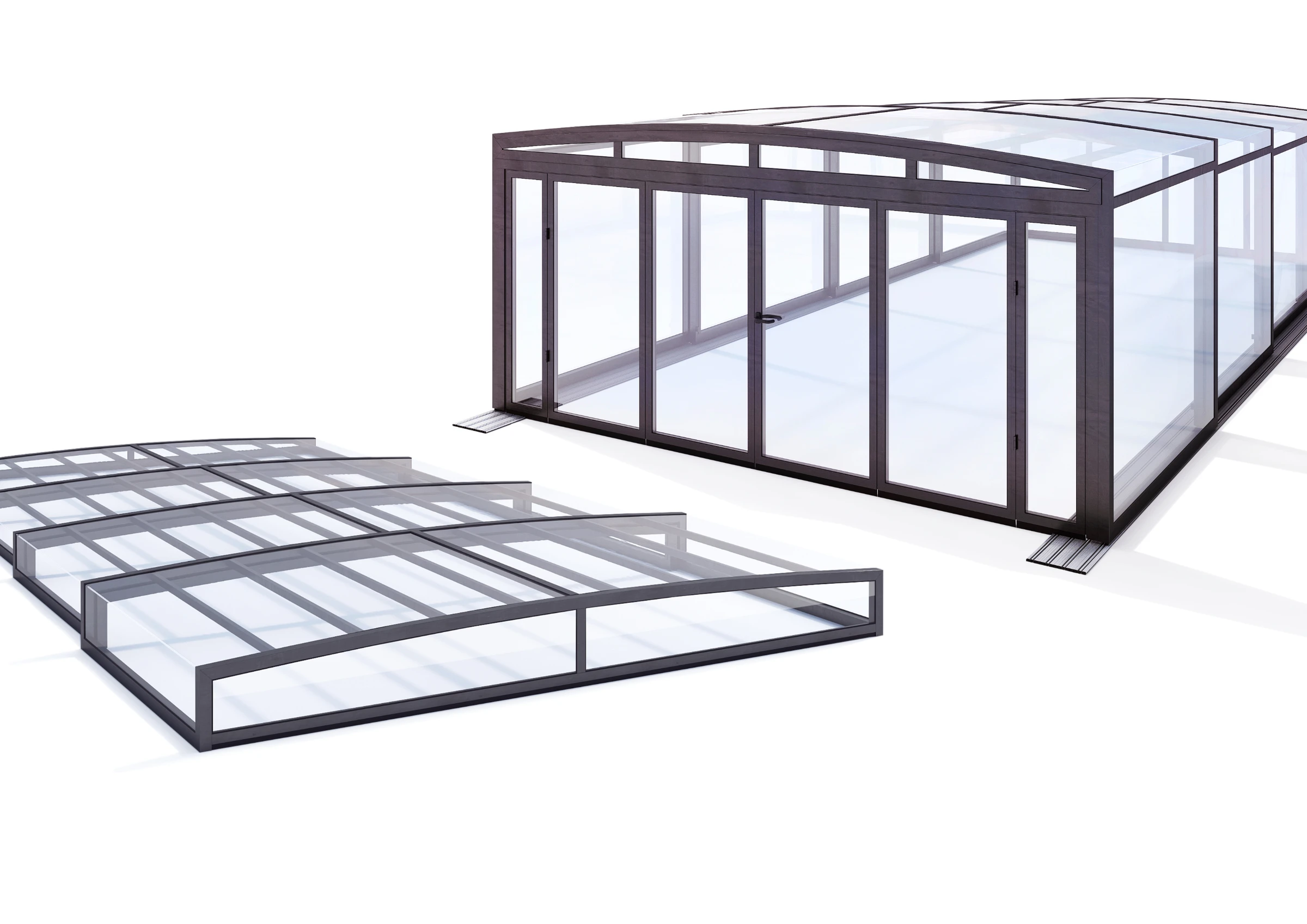
Low or High? Which Pool Enclosure Suits Your Lifestyle
An unobtrusive design that doesn't spoil the view, or a space where you can comfortably stand up and get changed even in the rain? We compare low, high and asymmetric pool enclosures by comfort, physics and structural demands – and help you decide which suits your lifestyle.
You are facing a fundamental decision: do you want an unobtrusive design in your garden that doesn't spoil the view, or do you prefer a space where you can comfortably stand up and get changed even in the rain? We will help you get your bearings among the basic types of structure.
The choice of the overall height of a pool enclosure represents an absolutely crucial moment when planning your investment. It is not just about the architectural impression, but above all about everyday functionality and applied physics. Each variant offers completely different possibilities of use and requires a different engineering approach. To make your decision easier, we have prepared a detailed comparison of the main benefits of the individual structural types.
1. Low Enclosures: Minimalism and an Uninterrupted View
Low and ultra-low enclosures are primarily designed for modern architecture, where the emphasis is on clean lines and absolute visual discretion. The height of these structures usually ranges from a few dozen centimetres to roughly one metre. The main goal is for the transparent pool cover to stay visually out of the way in the garden and not to spoil the view from the living-room windows.
From an engineering point of view, the low profile has excellent aerodynamic properties. In strong wind it does not create such a large obstacle and minimises the risk of dangerous uplift. You can swim without any problem even under such a low profile. The space beneath the segments is fully protected from debris, while the small volume of air inside heats up very quickly thanks to the passive solar effect. The enclosure thus fulfils its insulating function one hundred per cent, but it does not allow free movement around the pool. Once you have finished swimming, you have to leave the enclosure, which can be less comfortable for the user during damp weather.
2. High Enclosures: A Full-Fledged Space and Maximum Comfort
If you see the pool not just as a sports surface but as a year-round relaxation centre for the family, walk-in models are ideal for you. These more substantial structures usually reach a height of two metres and above. This creates a full-fledged covered pool hall that completely changes the dynamics of how the water is used.
Thanks to the sufficient interior height, you can comfortably stand up, dry off, get changed, or permanently set out relaxation loungers beside the pool. The space works independently of the weather outside. The larger volume of air does require a little more time for the initial solar heating, but once the climate stabilises, a high enclosure provides unbeatable user comfort. Given the more extensive roof and side surfaces and the associated higher wind and snow load, these systems use considerably stronger load-bearing aluminium profiles and more substantial anchoring into the base paving. Ventilation vents are also more frequently installed here for the effective regulation of internal humidity.
3. Asymmetric and Atypical Structures: A Smart Compromise
The choice of dimensions is not always strictly binary. Many plots require an individual and technically more demanding approach, which is why manufacturers offer sophisticated asymmetric enclosure shapes. These models have one side higher (fully walk-in) and the other side gently descending in the form of an elegant arch. This shape is most often used for pools located in the immediate vicinity of the house wall, where the high part serves as a corridor for safe movement along the entire length of the pool.
Atypical and one-sidedly anchored variants work as an excellent solution for difficult terrain, where a standard arched structure would fail spatially or statically. By combining a high walk-in zone on one side and a low segment on the other, you get the best of both worlds – plenty of free space to move around and the partial preservation of an open view into the greenery on the opposite side of the pool. The single-rail sliding system also saves precious space on the ground.
Conclusion: Respect Your Needs and the Statics of the Structure
The decision between a low and a high type of enclosure should always be based on your real needs and the technical possibilities of the plot. If your goal is discreet integration into the terrain and you rely more on purely sporting swimming, the low profile will reliably meet your expectations. If, however, you want to turn the pool into a dry and warm relaxation room with space for loungers, from an engineering point of view it pays to invest in a more substantial walk-in structure. Both paths will guarantee you maximum protection of the water and a significant reduction in running costs, while maintaining top-quality materials.
Want to know which enclosure suits you best?
Get in touch and we'll prepare a no-obligation, tailor-made quote.
Contact us