
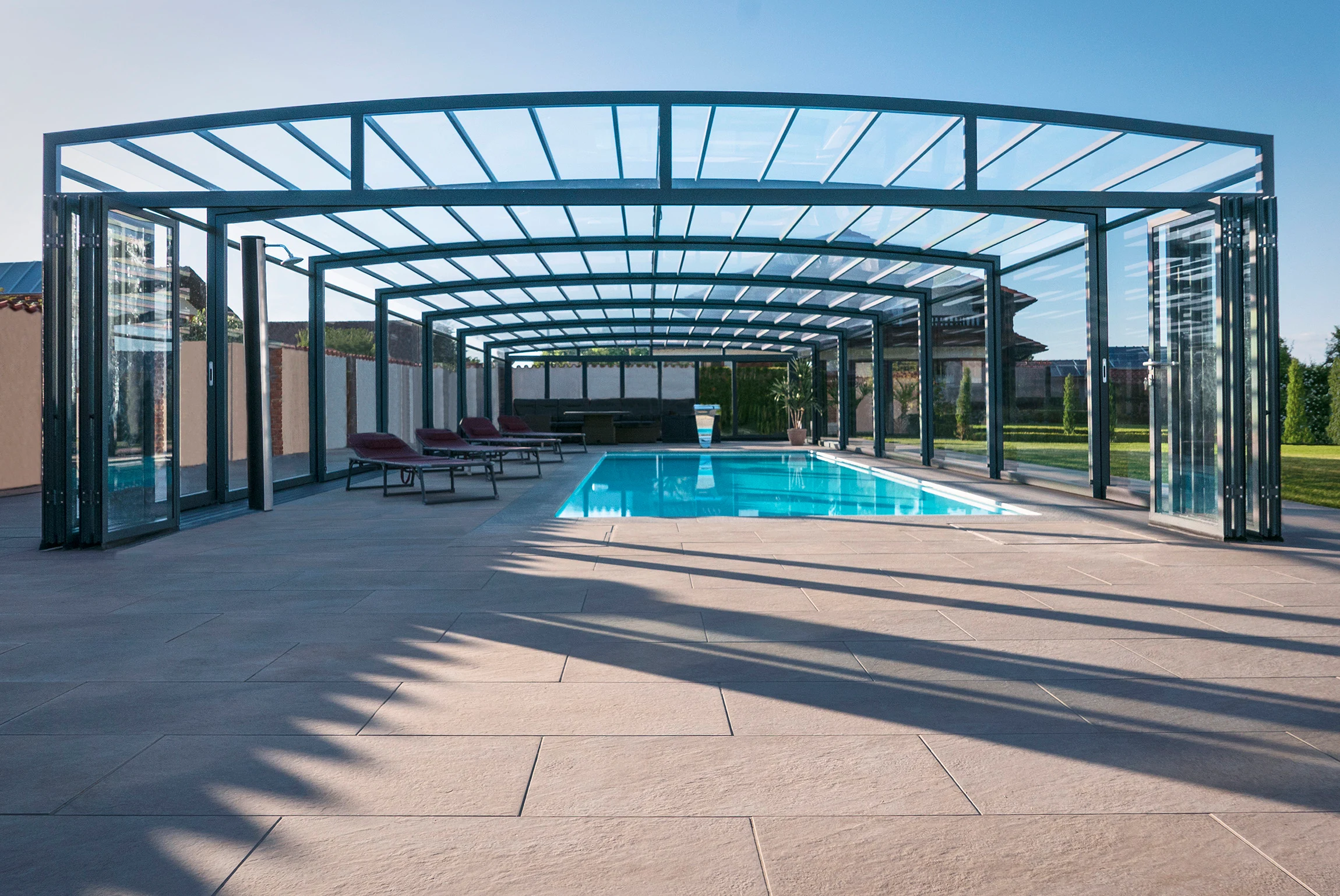
Generous Space and Easy Sliding: What's Behind the Effortless Operation?
A walk-in enclosure weighs hundreds of kilograms, yet a single person slides it smoothly with one hand. We look under the bonnet of the sliding systems – polyamide wheels, sealed stainless-steel bearings, the torsional rigidity of the profiles and hidden electric motors that turn moving it into an illusion of weightlessness.
Although walk-in models make a massive impression, a single person can move them smoothly and effortlessly. We'll focus on the detailed functioning of the sliding systems and quality bearings that make moving the entire structure a surprisingly easy affair.
When you first stand in front of a full-fledged, walk-in pool or terrace enclosure, its scale amazes you. These architectural elements often span 4 metres or more and are fitted with dozens of square metres of safety glass or polycarbonate. The total weight of a single sliding segment thus quite commonly runs into hundreds of kilograms. A layperson's logical reasoning suggests that setting such a colossus into smooth motion necessarily requires great physical strength and the assistance of several adults. The reality of modern engineering, however, is quite the opposite. Thanks to the strict application of the laws of kinetics, advanced metallurgy and precise mechanical engineering, only a light pull of one hand is enough to slide a huge wall aside. Let's take a look under the bonnet of these systems and break down the technological details that create this illusion of weightlessness.
Physical Principles and Minimising Rolling Resistance
The fundamental task of designers when creating large-format sliding systems is overcoming static friction. While on cheap, mass-produced structures the wheels often skid, snag or hit unevenness, premium systems are designed with the primary goal of reducing the coefficient of rolling resistance to the absolute technical minimum.
The key to success is the precise distribution of weight. The enclosure is designed so that its centre of gravity lies exactly on the axis of the running track. Once the enormous vertical mass of the segment is ideally balanced and directed perpendicularly into the axis of rotation of the running wheels, no parasitic side friction arises to slow the movement. The kinetic energy you put into the system by merely pushing with your hand is thus transferred without loss into linear forward motion. Once the initial static resistance is overcome, the heavy segment maintains its inertia and literally glides along the rails.
The Engineering Heart: Polyamide Wheels and Sealed Bearings
The mechanical element that bears the entire load and mediates the movement itself is hidden inside the lower aluminium profiles. These are not the ordinary plastic wheels you know from common hobby equipment. Premium models use exclusively high-load wheels turned from engineering plastics, most often extruded polyamide (PA6) or special polyurethane. These materials are characterised by enormous compressive load capacity, dimensional stability and, above all, incredibly low wear even under high daily loads.
The real technological core of these wheels, however, is the bearings. In the extremely aggressive environment of pool chemicals, constant humidity and salt evaporating from salt chlorinators, ordinary steel bearings would corrode within a few short weeks. That's why the running wheels are often fitted with top-quality stainless-steel bearings that are sealed on both sides (2RS standard). These Teflon or rubber seals hermetically close off the inner ball track with a permanent lubricant filling. Water, dust and aggressive chlorine thus don't reach the rolling elements at all. The result is completely silent running and zero need for service lubrication throughout the entire lifetime of the enclosure.
The Architecture of the Guide Tracks and Asymmetric Kinetics
For the movement to be smooth, not only the running gear itself must be perfect, but also the track along which it moves. The modern trend of flat, so-called walkable rails brought an enormous challenge. The rails lost their former height, which naturally prevented derailment, and were reduced to ultra-flat aluminium profiles integrated directly into the paving.
The guide groove in these rails is milled to a millimetre tolerance precisely to the width of the guide spur of the polyamide wheel. This absolute precision guarantees that the wheel has no room for lateral deviation – the so-called shopping-trolley effect, where the wheels start to vibrate or oscillate from side to side during movement, is eliminated. In the case of asymmetric systems with one rail and free wheels on the other side, the desired barrier-free sliding of the entire wall is also achieved. While one side holds the exact geometry of the movement, the other side merely follows the floor freely. This system makes it possible to connect the exterior and interior into one seamless whole without any protruding thresholds and obstacles.
The Torsional Rigidity of the Profiles as Prevention Against Racking
The physics of moving large-format elements hides one more pitfall, namely the racking or skewing of the structure. Imagine you are pushing a segment seven metres wide from just one of its edges. If the load-bearing structure were soft and pliable, its rectangular plan would immediately deform into the shape of a parallelogram. The guide wheels would jam in the rails and the whole system would seize up irreversibly.
In order to slide a huge segment smoothly even under pressure applied on only one side, the structure must have extreme torsional rigidity (resistance to twisting). This is achieved by using high-quality aluminium alloys (e.g. AlMgSi) that are extruded through special dies. This creates massive profiles with internal polygonal chambers and stiffening ribs. At critical points and in the corners, these profiles can additionally be connected by robust concealed corner brackets, which guarantee that the entire frame maintains an absolutely exact right-angled geometry under any circumstances. It is precisely this hidden mechanical rigidity that ensures the force of your push is immediately and evenly distributed to both sides of the segment.
Smart Automation: When Technology Takes Over
Although the manual operation of modern systems is exceptionally easy thanks to the technologies described, when absolute user luxury is required, sophisticated automation comes into play. Customers today rightly refuse to spoil the clean lines of their garden with unsightly external boxes containing motors and visible wiring.
The answer to these requirements is a fully integrated electric drive that you never notice. Technological development has made it possible to miniaturise powerful motors to such an extent that they are completely hidden directly inside the base aluminium profiles of the enclosure itself. These low-voltage drive units (often powered by discreet solar panels integrated into the frame, and therefore entirely without the need for supply cables) have their own intelligent control unit. The motors on both sides of the segment continuously communicate electronically with each other and synchronise their speed, thereby guaranteeing a millimetre-precise linear movement. Integrated sensors also continuously monitor resistance; if the system detects even the slightest obstacle in the way, it stops running immediately and safely.
In Conclusion: The Synergy of Mass and Invisible Assistance
The combination of high weight and extremely light operation represents one of the greatest paradoxes, but at the same time one of the triumphs of modern structural engineering. A quality, full-fledged enclosure will reliably protect you from a winter storm and bear tonnes of wet snow, but as soon as the sun comes out, it will let you open up the space with a single graceful movement.
Whether you decide on a system powered by your hand using top-quality sealed bearings, or choose the absolute comfort of completely invisible integrated electric motors controlled by a smartphone, you get a technological gem. You get an enclosure that will never become a burden in your garden, but will always represent a luxurious and one-hundred-percent functional extension of your living space.
Want to know which enclosure suits you best?
Get in touch and we'll prepare a no-obligation, tailor-made quote.
Contact us