
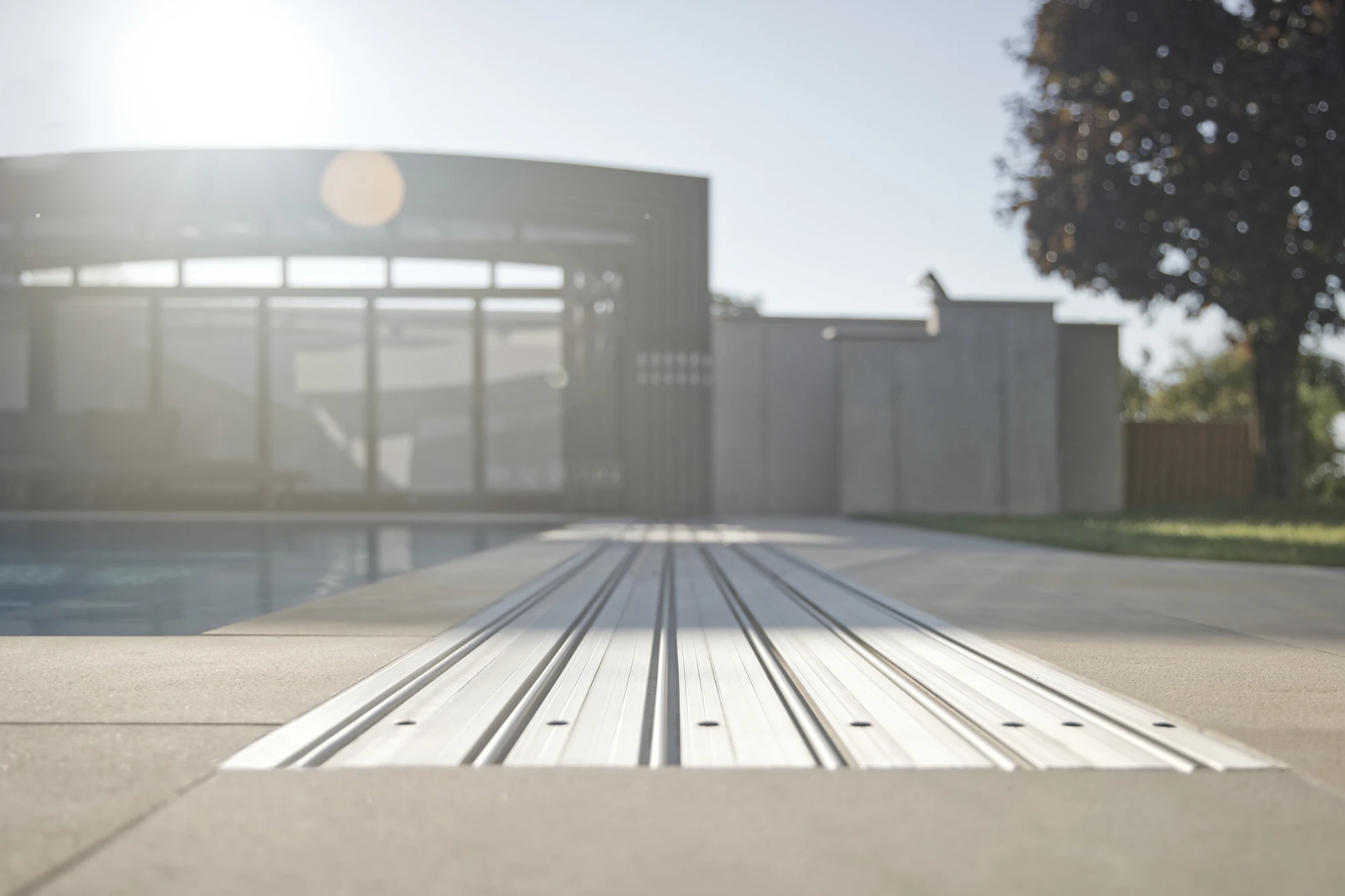
Concrete, Wood or Paving? How to Prepare the Right Base for Anchoring Your Enclosure
The choice and proper preparation of the surface around your pool determines how securely your enclosure is anchored and how smoothly it runs for years to come. Here is an overview of the solutions that work, as well as the materials you should avoid.
Concrete and fully bonded tiles
- The foundation of any continuous surface must always be reinforced concrete.
- If you use outdoor ceramic tiles, they must be fully bonded to the base across their entire surface, otherwise they are liable to crack.
- Directly beneath the track itself, it is best to leave bare concrete.
- If we are installing on existing tiles, they must be cut on both sides of the track. The resulting 10 mm expansion joint is then filled with a flexible sealant (e.g. silicone).
Timber decking and WPC (composite) decking boards
- The support joists must be firmly fixed to a concrete base so that the structure can withstand wind loads. The decking boards are then fixed to these joists.
- WPC boards with a concealed fixing system (grooves and clips) require additional anchoring to prevent lengthwise movement.
- For the trackless and single-track versions, the boards must run across the direction of travel (perpendicular to the guide track).
- It is essential to choose materials with minimal thermal expansion, so that the deck does not deform and the track spacing does not change.
Concrete strip foundations
- If the area around the pool is not a single continuous hard surface (for example, if it is surrounded by lawn), concrete strip foundations must be built beneath the guide tracks.
- The strip must be wide enough: it has to extend at least 25 mm beyond the footprint of the track on each side.
Warning: surfaces to avoid at all costs beneath the track
These solutions do not provide sufficient anchoring strength and carry the risk of uneven settlement or the structure being torn out:
- Paving on pedestals (spacer pads).
- Loose-laid paving (laid only on gravel or a compacted base).
- Lightweight concrete (e.g. polystyrene concrete).
Bear in mind, too, that standard anchoring with screws and wall plugs does not in itself create a watertight joint, which is why careful building preparation with a solid, continuous base is irreplaceable.
Choosing and preparing the right surface is the key to perfect stability and a long service life for your enclosure. We will gladly discuss the specifics of your site with you and recommend the safest anchoring method. Write to us or give us a call for a no-obligation consultation on your project.
Want to know which enclosure suits you best?
Get in touch and we'll prepare a no-obligation, tailor-made quote.
Contact us