
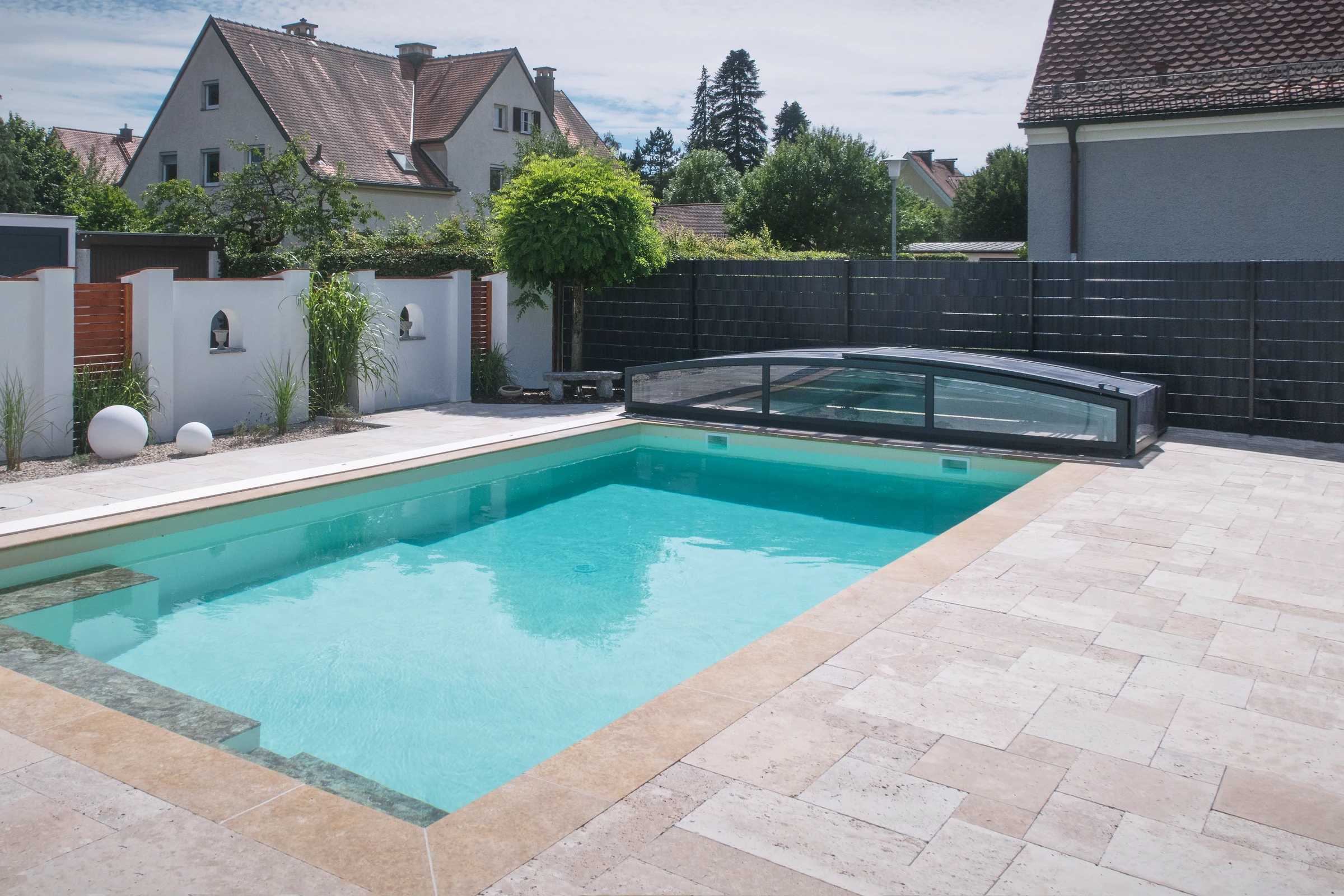
Clean Water With No Effort: How an Enclosure Saves Pool Chemicals and Your Time
Say goodbye to weekends spent with a net in hand. An enclosure works as a barrier against leaves, pollen, and rain, and thanks to its UV layer it cuts pool chemical consumption by up to 70%. How does it work, and how much time and money will you save?
Buying a pool means fulfilling a dream of perfect summer relaxation. With open bodies of water, however, the reality often looks rather different: weekends spent with a net in hand, constant measuring of pH values, dosing chlorine, and fighting green water. In this respect, a pool enclosure becomes a literal game changer.
The enclosed space above the pool doesn't just hold in heat. It works as an absolute physical and chemical barrier that protects the water from external influences. Read on to learn what processes take place beneath a quality structure, by how many percent your pool chemical consumption drops, and why you'll never again have to spend hours on the tedious vacuuming of the bottom.
1. A Physical Barrier Against Organic Contamination
The greatest enemy of clean water is organic waste. Falling leaves, pine needles, grass from the mower, small insects, and the ever-present spring pollen — with an uncovered pool, all of this ends up directly in the water. As soon as this organic matter begins to decompose, it becomes the perfect breeding ground for bacteria and algae.
A well-sealed enclosure stops this process right at its root. Thanks to layered sealing systems and precisely fitting profiles, mechanical contamination has no chance of getting inside. This removes the need for daily skimming of debris from the surface as well as the weekly vacuuming of the bottom.
The Difference in Maintenance (Open vs. Covered Pool)
| Maintenance criterion | Open pool | Covered pool |
|---|---|---|
| Vacuuming the bottom | 1–2× a week | Once a month (often only as a precaution) |
| Skimming debris with a net | Daily | Almost never |
| Filter backwashing | Very often (it clogs up) | Minimally |
2. An End to pH Swings After Summer Storms
Summer storms and heavy rain are a disaster for open pools. Rainwater has a markedly different pH than the water in the pool (it tends to be more acidic). On top of that, heavy rain washes dust and smog particles from the air into the pool. The result is an immediate drop in water quality, which usually calls for an application of shock chlorine, pH balancers, and algaecides.
A solid structure made of polycarbonate or safety glass eliminates this problem entirely. The water in the pool is hermetically separated from external weather influences. As a result, the water stays crystal clear even after a strong storm, its chemical balance is in no way disrupted, and you can go swimming without worry the moment the rain stops.
3. Up to 70% Lower Pool Chemical Consumption
Many pool owners have no idea that the biggest destroyer of chlorine in the water isn't bacteria, but direct UV radiation from the sun. During a hot, sunny day, UV radiation can break down up to 90% of the unprotected active chlorine in an open pool within just a few hours.
The glazed panels of modern enclosures are fitted with a special UV layer. While it lets through the thermal spectrum of sunlight (which is what heats the water), it safely blocks the destructive UV rays.
What does this mean in practice?
- Chlorine stability: The disinfection lasts much longer in the water.
- Less chemical odour: Lower dosing means less chlorine smell and zero irritation of the eyes or skin.
- Major financial savings: Consumption of all pool chemicals drops on average by 50 to 70%. The return on your investment in an enclosure therefore speeds up year after year.
4. The Synergy of Temperature and Cleanliness
When the perfect chemical stability of the water is combined with the solar effect mentioned above, an ideal swimming environment is created. You don't have to constantly "shock" the pool with chemicals, nor wait for it to warm back up after rain. The result of this smart ecosystem is the fact that you gain several extra months of swimming, in complete comfort and with minimal running costs.
5. Time Invested in Relaxation, Not Maintenance
While the pool technology and structure work for you, your only "job" shrinks down to the occasional check of the values on the dosing station's display. The enclosure structure itself is designed to be essentially maintenance-free, requiring only an occasional rinse to remove dust from the polycarbonate or glass panels, so that their maximum solar and aesthetic effect is preserved. If you want to keep the structure in perfect condition over the long term, we've prepared some practical tips on how to care for your enclosure for you.
An investment in a premium enclosure is thus not merely an investment in design. It's a step towards finally having your pool bring you nothing but joy, rest, and healthy exercise — rather than another never-ending list of household chores.
Want to know which enclosure suits you best?
Get in touch and we'll prepare a no-obligation, tailor-made quote.
Contact us