
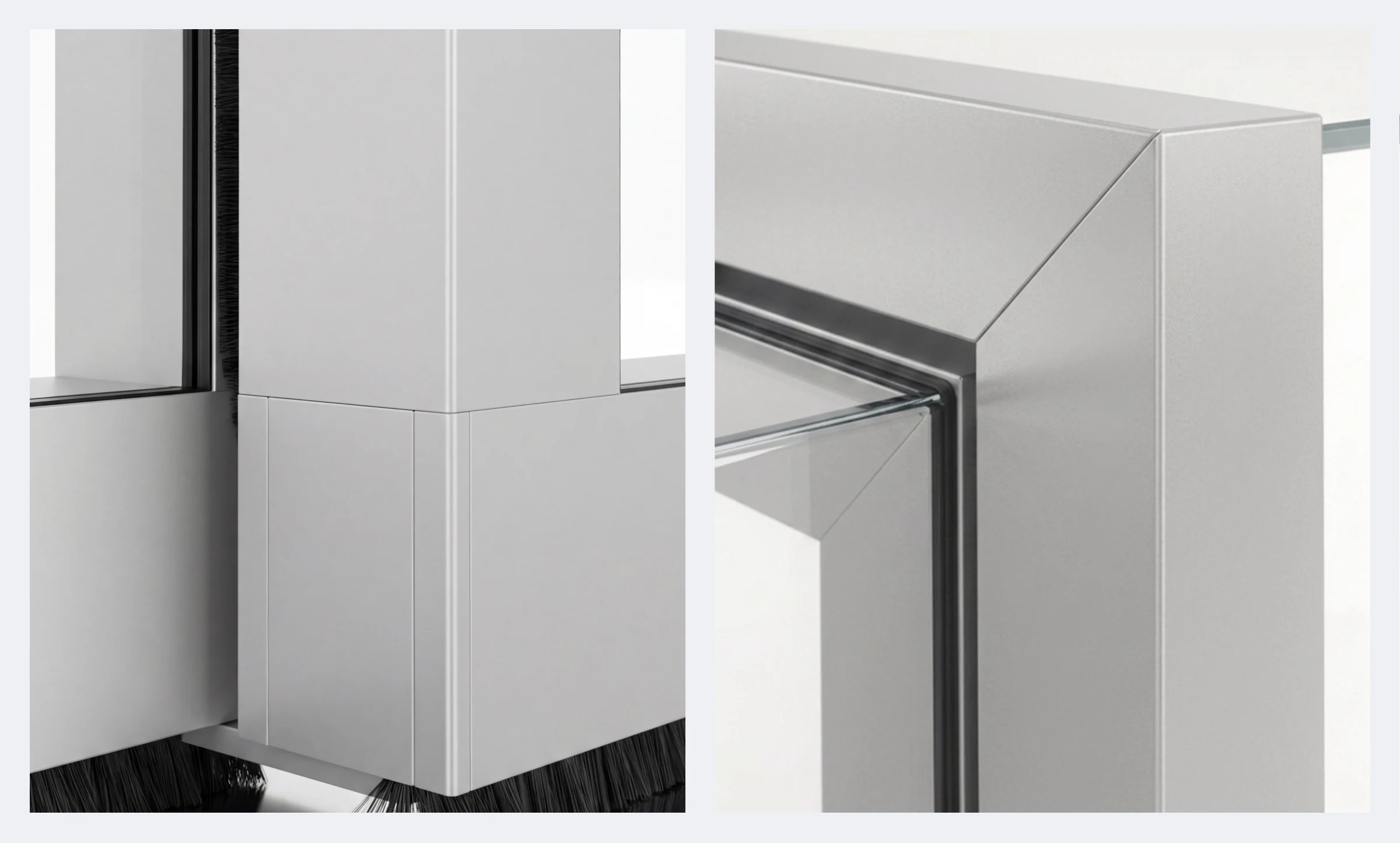
Understated Luxury: Why the Absence of Visible Screws Marks a Premium Solution
Dozens of rivets and protruding screws give a cheap structure away at first glance. We explain how concealed internal joints work, why they are stronger and more corrosion-resistant, and how the absence of external technical elements turns an enclosure into an architectural feature of the garden.
The idea of luxury in modern architecture has changed radically over recent decades. While luxury used to be defined by ostentation and an accumulation of elaborate details, today's premium standard speaks the language of minimalism, absolutely clean lines and uncompromising functionality. Genuine quality no longer shouts its presence to the world; it fulfils its purpose discreetly and elegantly. Quite naturally, this sophisticated approach is moving out of the interiors of modern villas and outdoors as well, towards pools and terraces. A pool enclosure is simply no longer seen as a mere necessary technical accessory, but as an integral part of the house.
When you look closely and critically at ordinary, mass-produced pool enclosures, you are probably struck straight away by the sheer amount of visual noise. Dozens of visible rivet heads, chunky steel screws protruding from aluminium profiles, plastic caps that soon lose their colour in the sun, and exposed external corner connectors. All of it creates needless technical clutter that disturbs the elegance of the garden. Our premium structures, however, take the opposite path entirely. Let's take a detailed look at how a system of concealed joints works and why the absence of external technical elements is clear proof of the highest engineering quality.
Moving Away from Compromises and the New Role of the Outdoor Space
To understand why we devote so much energy and development to eliminating every visible screw, we have to look at the wider context of how industrial design is perceived in the garden. Customers today invest considerable sums in large-format seamless paving, designer outdoor lighting and smooth transitions between the living room and the terrace. Adding a crude structure to such a setting – one that resembles an industrial greenhouse hastily assembled with a drill – is entirely unthinkable.
Our goal is to create enclosures that read like a delicate glass sculpture or a light architectural element. Purity of form, without disruptive fasteners, allows the eye to glide smoothly across the surface of the structure without snagging on unsightly mechanical details. The result is visual calm and harmony that lets the water surface itself and the surrounding architecture come fully into their own.
The Technology of Concealed Joints: Engineering the Invisible
The absence of visible screws is not merely a matter of aesthetics, though. Above all, it is an enormous technological challenge. Joining two substantial aluminium profiles so that the joint withstands extreme snow and wind loads while remaining completely invisible from the outside demands an entirely different approach to manufacturing and design.
Ordinary manufacturers take the path of least resistance: the profiles are simply placed together and drilled through from the outside with a self-tapping screw, or riveted. This solution is cheap and quick, but technically and visually very imperfect. Premium structures instead use a carefully engineered system of internal corner brackets and concealed locks.
Material Integrity and Corrosion Prevention
You may be thinking that aluminium doesn't rust, so why should an ordinary screw be a problem? The truth is that while aluminium itself is not subject to classic corrosion the way steel is, it is prone to other forms of degradation if it isn't handled correctly. And this is precisely where we come up against another major disadvantage of visible joints.
When a structure is surface-treated – whether with highly durable powder coating or with anodising – an impermeable protective layer forms on the metal. The flawless look of the surface and current trends in surface finishes now make it possible to achieve luxurious matte textures, subtle structural colours or convincing imitations of other materials. But if you take a drill and make a hole for a rivet or screw in that perfectly protected profile from the outside, you damage this protective layer irreversibly.
You expose bare metal in exactly the place where water will constantly collect. What's more, into that exposed spot you often insert a fastener made of a different metal (stainless-steel or galvanised screws, for example). In the aggressive environment of pool chemicals, humidity and salt solutions (if you use a salt chlorinator), this creates the ideal conditions for so-called galvanic corrosion. On cheap structures, unsightly white blisters of oxidised aluminium therefore often appear around external rivets and screws over time. With a system of concealed joints, the profile's outer protective layer remains completely intact along its entire length, guaranteeing extreme longevity and a flawless appearance for decades.
Structural Resistance: Concealed Joints Mean Greater Strength
There is a mistaken belief that unless you bolt a structure right through with a hefty screw, it won't be strong enough. In the case of modern aluminium systems, however, the laws of mechanics and structural engineering are clear: internal pressed and interlocking joints are in fact far stronger and more resistant to material fatigue.
When you join materials at a single point (with a rivet or screw from the outside), all the stress, wind loads and snow pressure concentrate in one tiny spot – in the screw thread and the thin profile wall at the drill hole. Under extreme loads, the opening can tear out or become "chewed up" here. A system of concealed internal corner brackets, by contrast, distributes these enormous forces across a far larger area inside the profile chambers. The solid aluminium core within the joint ensures that the entire load is transferred smoothly into the whole structure. The enclosure segments therefore withstand spring gales, powerful gusts of wind and unexpected loads of heavy, wet snow without any difficulty – while still keeping their elegant face.
Rewriting the Rules of Pool Aesthetics
We often meet customers who initially approach the idea of an enclosure with a great deal of scepticism. To them, an enclosure is a necessary evil, a compromise they have to make because of the children or the upkeep of the water. And this is exactly where our products systematically dismantle entrenched myths about a disruptive appearance.
We explain and show them that an enclosure doesn't have to look like a technical barrier that devalues their beautifully planted garden and the view of the modern house façade. Concealed joints, smooth transitions from glass into frames and the absence of intrusive rails turn our premium models into an architectural gem. When you look at an enclosure like this, all you perceive are clean lines and the uniform, unbroken colour of the aluminium frames. There is nothing here to needlessly draw your attention or to look cheap and unfinished.
Visual Cleanliness Hand in Hand with the Practical Kind
Finally, we mustn't overlook one more absolutely crucial benefit of having no external screws: a radical simplification of maintenance itself. Every exposed technical joint on an outdoor structure naturally acts as a magnet for dirt. Screw heads, nuts, the folds of external corner connectors or the outlines of crude plastic caps – all of these are microscopic obstacles that catch drifting dust, aggressive spring pollen from flowering trees, cobwebs and small insects.
When you simply rinse with a garden hose, this dirt is very hard to remove from such an uneven surface, and sooner or later it forces you to pick up a cloth and laboriously wipe every single screw by hand. Our structures, with their completely smooth, flowing surface, eliminate this problem at the root. A smooth, uninterrupted aluminium surface can simply be rinsed off with water or wiped clean in a single sweep. Maintenance thus becomes a matter of just a few minutes.
In Conclusion: Details Make Perfection
Charles Eames, one of the most celebrated designers in history, once said: "The details are not the details. They make the design."
Every invisible joint, every screw kept out of sight and every concealed technological refinement is proof of respect for the architecture of your home and for your time. Choosing a modern solution without disruptive elements is therefore not only an investment in a better-looking garden, but above all an investment in enormous durability, safety and overall user luxury that will bring you pleasure every day – month after month, year after year.
Want to know which enclosure suits you best?
Get in touch and we'll prepare a no-obligation, tailor-made quote.
Contact us